

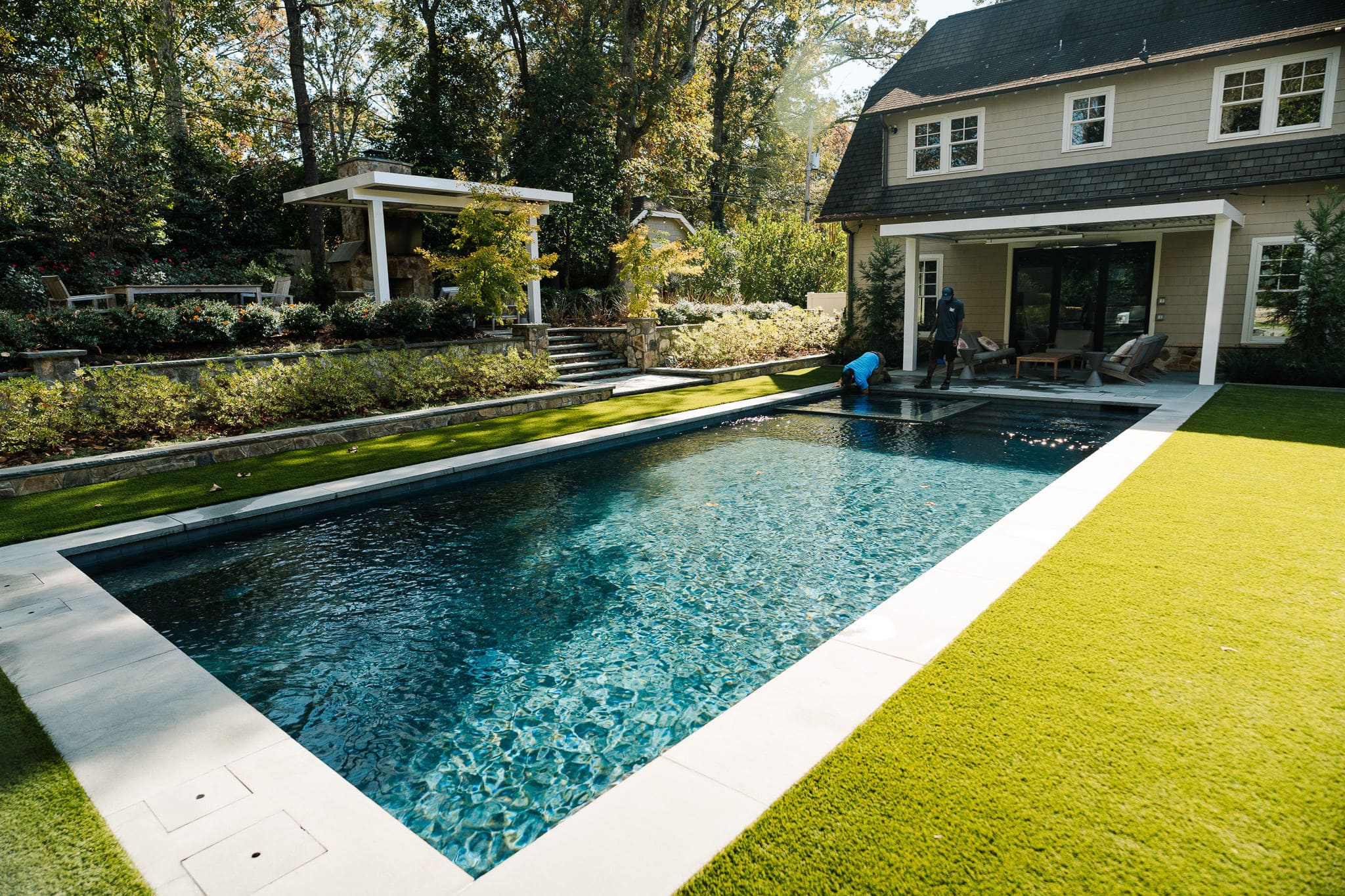
If you’ve started researching custom pool construction, you’ve probably come across the terms gunite and shotcrete used somewhat interchangeably. That’s understandable, since both refer to a similar method of applying concrete, and both produce the same end result: a durable, fully customizable concrete pool shell. But there are real differences between the two, and understanding them helps you have a more informed conversation with your pool builder.
What Gunite and Shotcrete Have in Common
Before getting into the differences, it’s worth understanding what these two methods share. Both gunite and shotcrete are spray-applied concrete techniques used to build the structural shell of a custom pool. In both cases, the process looks similar:
- The pool area is excavated to the specified shape and depth
- A steel rebar framework is installed to reinforce the shell
- The concrete mix is sprayed onto the rebar framework under high pressure through a hose and nozzle
- The applied concrete is hand-finished by skilled trowel workers while it’s still workable
- The shell cures before interior finishing (plaster, pebble, or aggregate) is applied
Both methods are prized in custom pool construction because they allow virtually unlimited design flexibility. Curves, vanishing edges, tanning ledges, spas, and complex geometries are all achievable with either gunite or shotcrete in a way that’s much harder to replicate with poured concrete forms or vinyl liner systems.
The Key Difference: How the Concrete Mix Is Prepared
The real distinction between gunite and shotcrete comes down to how and when the concrete mix is combined with water.
Gunite (Dry-Mix Process)
Gunite uses a dry-mix process. The dry cement and aggregate mixture is loaded into the spray equipment, and water is added at the nozzle as the material is being sprayed onto the rebar framework. This means the water-to-cement ratio is controlled by the nozzle operator in real time, which requires significant skill and experience to get right consistently.
Shotcrete (Wet-Mix Process)
Shotcrete uses a wet-mix process. The concrete is fully mixed with water at the batching plant or on-site before it ever reaches the spray equipment. The pre-mixed, engineered concrete is then pumped through the hose and sprayed onto the rebar framework as a complete, ready-to-apply mixture.
Because the water-to-cement ratio is precisely controlled at the mixing stage rather than at the nozzle, shotcrete tends to produce a more consistent, predictable strength outcome from batch to batch.
Why This Difference Matters
The dry-mix versus wet-mix distinction has real implications for the finished pool shell.
Strength Consistency
Because shotcrete’s water-to-cement ratio is engineered and controlled before application, it tends to produce more consistent compressive strength throughout the shell. With gunite, strength can vary depending on how skillfully the nozzle operator manages the water content during application, which is why gunite quality is so closely tied to the experience of the crew applying it. For this reason, high-consequence structures like skyscrapers – where strength consistency is imperative, and variability is unacceptable – are built using shotcrete.
Rebound and Material Waste
Both methods produce some rebound, which is material that bounces off the surface during spraying rather than adhering. Generally speaking, shotcrete tends to produce less rebound than gunite, which can mean less material waste and a cleaner job site, though this varies based on application technique and project specifics.
Application Speed
Shotcrete can often be applied more quickly once the mix arrives on-site, since it doesn’t require real-time water mixing at the nozzle. Gunite application speed depends heavily on the nozzle operator’s experience and the complexity of the shell being built.
Crew Skill Requirements
Gunite places more responsibility on the nozzle operator to manage water content correctly in real time. An experienced gunite crew can produce excellent results consistently, but the margin for error is tighter than with shotcrete’s pre-engineered mix.
Which One Is Better for Your Pool?
In practice, gunite has been the more widely used and historically dominant method in custom pool construction for decades, and an experienced gunite crew produces outstanding, long-lasting results. Shotcrete has grown in popularity as more contractors adopt wet-mix equipment, particularly for its consistency advantages.
The honest answer is that the quality of your finished pool shell depends far more on the skill and experience of the crew applying the concrete, gunite, or shotcrete than on which method is used. A highly experienced gunite team will consistently outperform an inexperienced shotcrete crew, and vice versa.
What matters most is working with a pool builder who has a proven track record, uses the appropriate rebar specifications for your design, and employs crews with deep experience in whichever method they use.
What to Ask Your Pool Builder
If you’re comparing pool builders and want to understand how they approach this part of construction, consider asking:
- Do you use gunite or shotcrete, and why do you prefer that method?
- How many years of experience does your application crew have?
- What rebar specification do you use, and how is it determined for different pool designs?
- How do you quality control concrete strength and consistency on a project?
- Can I see examples of pools you’ve built using this method?
A builder who can answer these questions clearly and confidently is a builder who takes the structural integrity of your pool seriously, regardless of which method they specialize in.
Built to Last, the B&B Way
At B&B Pools of the Carolinas, we bring decades of experience to every concrete pool shell we build. Our crews have decades of experience and are trained to deliver consistent, high-quality results. We also use tight placement of #4 rebar as our standard, because the structural integrity of your pool matters for decades, not just for the first few years.
Whether you’re planning a new custom pool or want to better understand the construction process, we’re happy to walk you through exactly how we build pools that last a lifetime.
Contact B&B Pools of the Carolinas to start the conversation about your custom pool project.